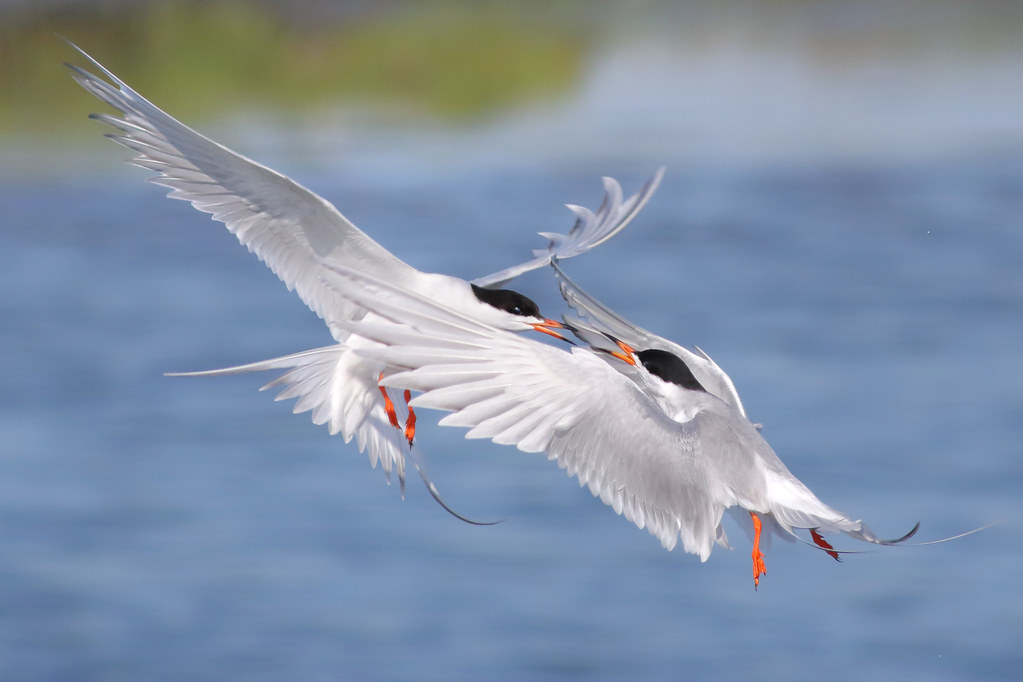
Forster's Tern Eying Lunch at Merritt Island, Florida by Paul Fernandez Via Flickr: Details best viewed in Original Size I photographed this Forster's Tern along the Black Point Wildlife Drive section of Merritt Island National Wildlife Refuge located immediately north of the NASA Space complex on Florida's Atlantic Coast. Once again these terns offered me some of the best shooting opportunities and some of the worst shooting conditions. The opportunities came when I consistently found them in several locations close to the side of the Black Point Wildlife Drive hovering and diving after their prey. Unfortunately, these are quick flying birds with very unpredictable flight paths. Their relatively small size made it imperative for me to use a very long, very heavy lens plus a 1.4 telex to obtain the large image that I wanted. The only solution to the problem was take plenty of time, shoot a lot (a couple of hundred) frames and hope that some would somehow turn out desirable. In other words, I used the probabilistic approach to photography – Use the best equipment you can afford, pre-adjust the exposure to the conditions, shoot a lot of frames and some will probably turn out to be acceptable. The Forster's Tern, named after naturalist Johann Reinhold Forster, breeds inland in North America and winters south to Florida, the Caribbean, and northern Central America. This species is rare but annual in western Europe, and has wintered in Ireland and Great Britain on a number of occasions. No European tern winters so far north. This species breeds in colonies in marshes and nests in a ground scrape and lays two or more eggs. Like all white terns, it is fiercely defensive of its nest and young. The Forster's tern feeds by plunge-diving for fish, but will also hawk for insects in its breeding marshes. It usually feeds from saline environments in winter, like most terns and usually dives directly, and not from the "stepped-hover" favored by the Arctic tern. The offering of fish by the male to the female is part of the courtship display. This is a small tern, 13 to 14 inches (33–36 cm) long with a 25 to 28-inch (64–70 cm) wingspan. It is most similar to the common tern and has pale grey upperparts and white underparts. Its legs are red and its bill is red, tipped with black. In winter, the forehead becomes white and a characteristic black eye mask remains. Juvenile Forster's terns are similar to the winter adult. The call is a harsh noise like a black-headed gull. Info above was extracted from Wikipedia.