


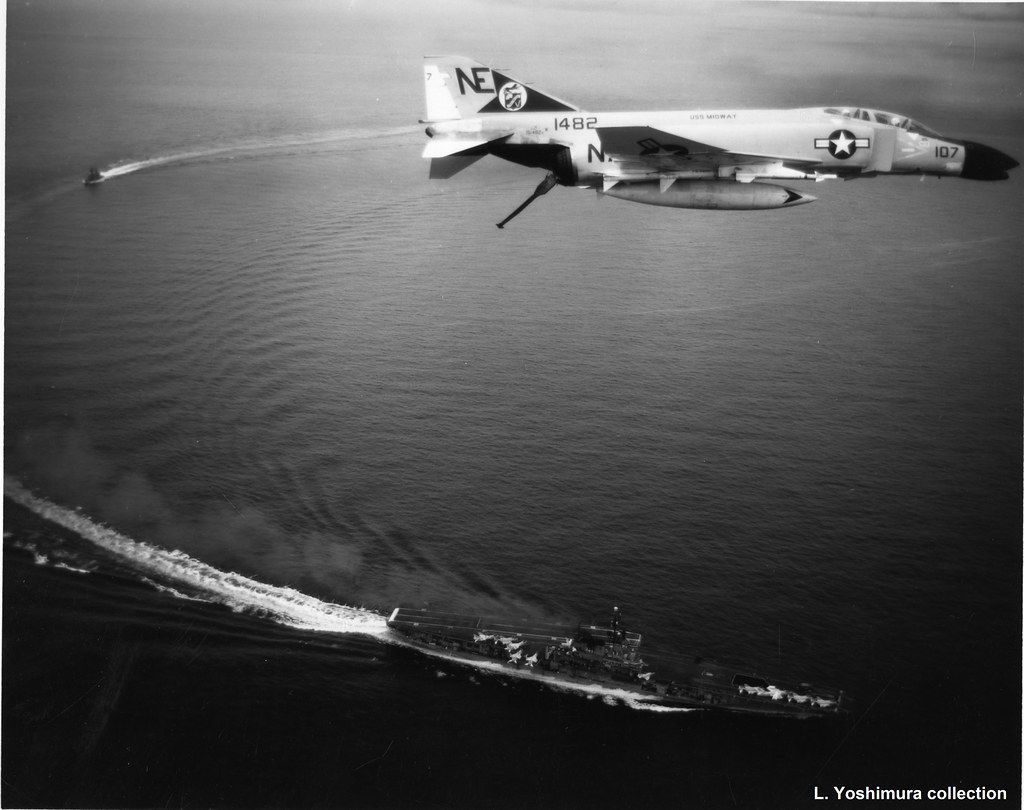
Vietnam war by Linh Yoshimura Via Flickr: Air to air view of F-4H Phantom of VF-21. USS Midway (CVA-41) in foreground during Task Force 77 operations. US National Archives photo. Notice: During the Vietnam War, twelve different commanders led CARDIV FIVE and CTF 77 in numerous combat deployments to the Vietnam War zone. Beginning in 1964, COMCARDIV FIVE was permanently deployed to the Western Pacific and dual-hatted CTF 70/CTF 77, homeported at Naval Air Station Cubi Point in the Philippines. During the Vietnam War, Task Force 77 conducted carrier strike operations from the Gulf of Tonkin and South China Sea for nine years, from 1964 to 1973. Twenty-one of the Navy's 23 operational carriers made at least one cruise with the Task Force and served over 9,100 days on the line. The nickname "Tonkin Gulf Yacht Club" came to be associated with US carrier operations off Vietnam. Rolling Thunder air strikes, armed reconnaissance, and photo reconnaissance missions were conducted against selected targets and lines of communication (LOC) in North Vietnam, while operational procedures were developed by the operating units, 7th Air Force and Carrier Task Force 77, that permitted the full range of coordination for all air operations in the Rolling Thunder program. As the U.S. Navy entered heavy combat in Southeast Asia between 1965 and 1968, a chain of command evolved which reflected the complex character of the war. In theory, Commander in Chief, Pacific was the commander of all American forces in Asia, including those assigned to Commander, U.S. Military Assistance Command, Vietnam (COMUSMACV). The U.S. Pacific Fleet was the naval component of the Pacific Command and as such directed the Navy's activities in that ocean. Subordinate to Commander in Chief, U.S. Pacific Fleet (CINCPACFLT) was Commander, U.S. Seventh Fleet, who conducted those naval operations in Southeast Asia primarily external to South Vietnam. The fleet's Attack Carrier Striking Force (Task Force 77) mounted from the South China Sea the aerial interdiction campaign in Laos and North Vietnam, while Seventh Fleet's cruiser and destroyer units hunted the enemy's logistic craft along the North Vietnamese coast, bombarded targets ashore, and provided naval gunfire support to allied forces in South Vietnam. From the South China Sea, the Seventh Fleet's Attack Carrier Strike Force mounted the Rolling Thunder bombing and Blue Tree tactical reconnaissance operations in North Vietnam; the Barrel Roll, Steel Tiger, and Tiger Hound bombing and Yankee Team reconnaissance efforts in Laos; and the ground support mission in South Vietnam. Except during the period in 1965 and 1966, when the aircraft carrier supporting operations in the South sailed at Dixie Station, the carrier task force was deployed at Yankee Station (after April 1966 at 17°30'N 108°30'E). Generally, before August 1966, two or three carriers operated in Task Force 77, and after that date the number was often three or four. During the Easter Offensive 1972 Five and Six carriers operated in Task Force 77. On each ship, a carrier air wing controlled 70 to 100 aircraft, usually grouped in two fighter and three attack squadrons, a reconnaissance attack squadron, an airborne early warning squadron, and smaller detachments. However, the number depended on the size and class of the carriers, which varied from the large-deck 65,000-ton Forrestal class and 70,000 Kitty Hawk class and Enterprise-class ships, to the modified 27,000-ton, World War II vintage Essex-class ships


