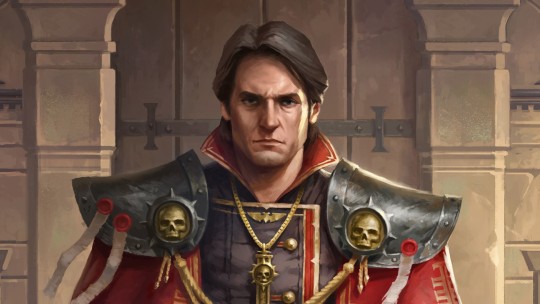
Warhammer - Kingsblade - Audio book - read by Christopher Tester (Heinrix VA)
So, maybe everyone except me has already seen it, but Kingsblade, which is the first of two books from Andy Clark (the second one is called Knightsblade) about Imperial Knight Pilots and the noble houses of Adrastapol is available as audio book - and read by Christopher Tester.
So if you like to learn more about Imperial Knight Pilots and listen to Heinrix's voice - this might be for you!
I have read both and I definitely recommend reading them - and while I am normally not one for audio books, having it narrated by Chris is definitely making me going to listen to it.
Not so long ago I emailed Chris Tester, the voice of Heinrix van Calox in Owlcat’s recently released CRPG Rogue Trader, and asked if he would like to sit for an interview with me. Having some experience in interviewing people I like, most famously Oscar winner and all-around sweetheart Eddie Redmayne, this was not a completely nerve-wracking endeavour. And within a day of sending my email, Chris said yes. And what a pleasure it was interviewing him: Chris was so generous with his time, that the agreed upon 30 minutes turned into 50 minutes as we brushed upon many topics from his start as a theatre actor to his first voice-over role in a video game to his recently discovered hobby of playing D&D. Of course, we also spoke about all things Warhammer 40k, his new found fame brought on by voicing Heinrix and the insights he could share about the character.
I will publish this interview in three parts over the next week in text form and with the accompanying audio file (the audio quality is not spectacular but tumblr limits uploads to 10MB). If you quote or reshare, please quote me as the original source.
Chris Tester: That's no problem. No problem at all.
F: So then let's start. You graduated in 2008.
CT: I did. Yes.
F: You started out as a stage actor. Did you always want to become a stage actor or an actor in general? Tell us a bit about your career.
CT: I always wanted to be a stage actor. Yes, as soon as I knew that I wanted to be an actor, which probably wasn't until I was a teenager. But yeah, my first passion was always the stage, and that was kind of borne out in my career. I would have been open to TV and film of course, if it had come along, I'm a huge fan of TV and film as well, but I never got an audition for any TV or film work.
I think I literally did about three short films in my 10, 12 years of actually professionally acting, and it is one of those industries where the more you do of one thing, the more you seem to find yourself doing the same thing to a degree. So yes, watching Shakespeare from an early age was one of my first passions.
And that was what first planted the seed of wanting to do it myself. The whole aspect of live performance is still something that I'm very passionate about. Up until 2020, when the world changed, I was trying to do two or three theatre shows a year, but since 2020, I haven't been near a stage and I doubt right now, especially with the way that the UK theatre scene is going, that I'm going to be back on stage anytime soon. I am resigned to that, but at some point in my career, I know I will be on stage again, because I can't live without it, but only for the right thing, both financially, but more importantly, creatively.
F: Your production company is currently on hiatus?
CT: I was the producer of a theatre company, which was run and was the baby of the director of the company, a guy called Ross Armstrong, who's one of the most talented writers and directors that I've ever worked with. I was helping out with a lot of the administration stuff so that he could still put me in plays. Instead of creating my own work because I'm not a very good writer or the best writer in the world, I support those people who will write me good parts. So yes, it is currently on hiatus, but never say never, we would always be looking to get back. It's difficult right now. It's difficult for all of us, because arts council subsidy, that way of being able to fund stuff, is drying up. We were doing a national tour of the UK when we were doing that [with the support of a subsidy]. There's even less money, there's even more people. I won't bore you with anything more than that, but it's kind of tough. We'd like to come back, but in the right way, and that's tricky to negotiate.
F: It's always hard as a stage actor to earn a living.
CT: Well, I've been spoiled by voice-over as well, and whereas when I was in my 20s and 30s then you're all about your art. And of course, I'm still all about my art, but I'm also about my wife and my cat and the mortgage and the bills and wanting to have nicer things to a degree as well. I've come to terms with that and voice-over does facilitate that as well as it opens you up to different roles and working with different people. So, I can't complain.
F: It's quite similar with making a living as a writer, because with a steady income you get used to a certain standard of living and once you have obligations and bills to pay, I think the stress on your mental health being creative and having all the stresses of regular life thrust upon you brings with it a challenge.
CT: It's a cliche we can very easily fall into: if I'm suffering, then it means I'm an artist. And that's not necessarily very true. It very often means that the art that we create only reflects one aspect of our lives, and it's usually a very tortured one. I am also about having wider experiences and broadening myself out. Whereas I think when I was in my twenties, I was thinking a bit more like: Oh, I'll experience the world and life through my art and just purely through my art. Whereas now necessarily I need to have a life outside of it as well, and then I can justify like I have the life so that I can feed my art or not, whatever. You know, I'll be a better artist by having a bit of a life outside of it. Maybe.
F: But that's what your twenties are for.
CT: Yeah, indeed.
F: Doing the crazy stuff, doing the band stuff
CT: Yeah, yeah, exactly. So, there was certainly an aspect of that in my twenties.
F: So, what brought you to voice acting or voice-over work initially?
CT: Money. Video game stuff is kind of sexy and cool, and I'm a gamer, so that's important. Before I was a video gamer, I was a board gamer and off the back of that, I was a voracious video gamer, partly because I wasn't very good at team sports at school. I was always the person who was picked last in the football team. So that becomes part of your identity for better or worse. But video games, I was pretty good at, not amazing, but I was pretty good at, and I enjoyed it. And it gave me a different form of escapism as well, and off the back of that I always had an interest in them.
So, the very first voiceover job was a video game: Dark Souls, which is quite a big franchise. At that time, I was your very typically jobbing actor. My acting agent came in and said: I got something for you. And so, I went in with that. But it was only in 2016, 2017 that I realised it was something that you could actually do yourself. People had recording studios at home and they were contacting people directly, not just going through agents. Because I'd basically written to the same 20 voice agents in the UK, mainly in London for like eight years in a row and not received anything. So, you keep knocking on those doors hoping.
Before I'd even graduated from drama school, I'd burnt a CD and made these cases with my headshot on it and sent them all off at what at the time felt like great personal expense and didn't get anything for eight years in a row. So, I was a bit like, I'm obviously doing something wrong, but I don't really know what, because I'm doing these workshops and getting good feedback. Then I found out through a couple of online courses, that there were ways and means of doing it myself, and that was a bit of a game changer for me, and within six months of having started, I was earning more through voice work than the bar job and the box office job that I was doing combined. Within six months, I was kind of like: “I gotta quit because I'm actually holding myself back from things.” So that was quite a big shift.
F: Somewhere you said, you started out under a duvet and with an oar.
CT: Yeah. On my website, I do have an image of it. [Dear reader, I could not locate this elusive photo] I literally had to take the duvet off my bed and put it into the living room, which was the quietest space in my then shared flat. I also had to wait until after one flat mate had watched TV and another one had used the table that had their washing on it. One of my flat mates had stolen an oar from some night out and that was perfect in order to be able to erect it over my head and the duvet as a frame.
I did probably the first four or five months of voice recording like that. Probably about 10, 15 voiceover jobs that I actually got paid for, I was using that because it worked well enough. Since then, I've gone through various different iterations of a setup in the bedroom, to a setup in the hallway, to my current setup. In 2020 we moved to our first house, and this is the spare bedroom which I've had converted into a studio, which means my cat can be here asleep on me or near me getting fur everywhere, but it's fine. I can thrash around and I've got natural light to work in at the same time, which I find quite important. [Pictured below Chris' current setup.]
F: Very pretty. That's good. Guide us through a typical day of yours, if you like.
CT: Oh, sure. I mean, there is no typical day. And yet, and yet, and yet. A typical day for me is, because I am spending the vast majority of the day sitting in this room or somewhere close to this room, because I may need to record at short notice, because the vast majority of jobs are quite short notice. My priority is exercise for mental health more than anything. I've got some weights at the bottom of the garden, and I will get up first thing, and I will go there and I will do that after breakfast. And that's my minimal routine of physical activity done.
And then I'll come back, and this is so rock and roll. Now what I do is, I spend like an hour on LinkedIn. And that's what you dreamed of as a creative person. Isn't it as an actor? I spend time on LinkedIn regularly every day, because it's a really good networking place for a lot of my types of work, and first thing in the morning, I'm a bit mentally sharper. So that's when I come up with a quick post that may be inspired by a bit of content that I've made elsewhere. That probably takes about 20 minutes and then I spend another 45 minutes to an hour engaging with people and saying hi and introducing myself and asking questions, whether that's with video producers or game developers or documentary makers or pretty much anything and everything. There are a lot of people who are active at that time. And so I do it.
And then after that, if I already have some recording lined up, then I'll prioritise mid-morning, because I've warmed up physically a bit more then, and I'm focused. So, you're going through the scripts, annotating the scripts, recording the scripts, editing the scripts. But then there could be live sessions at any time within that as well. I try to keep hours from nine till six. But occasionally, like with Rogue Trader, that was recorded at various different times of the day because we had people in New York, we had people in mainland Europe, and we had people in the UK. So all different time zones, so that can happen at any time.
And then I try to do other kinds of bits and pieces of marketing whenever I've got free time to. I do use really exciting productivity hacks, like time blocking. Again, not something that as a creative individual, I was like: Oh God, this gets me so excited, because it doesn't, but it works. It's finding a system that works for you, but still has a certain kind of flexibility and fluidity. I'm trying to make sure that I get outside of the house, and that kind of stuff.
Recently, over the last year, I’ve started doing audiobooks as well. That long form type of thing is quite nice to be able to dip into because sometimes you don't record for two, three days. You don't get the work. Nothing’s coming in. So, you’re marketing, but it kind of connects you back to the performance side of things to go: I can do a few chapters and you know, that kind of thing. So that's probably it. I try to formalise it, but you know, every voice actor’s day is radically different. There are people, some of the biggest names, going into different studios every week or every day. I very rarely, despite being based in London, I very rarely go into external studios. Like I would say 99 percent of the work I just do from home.
F: So how do you find the right voice for the specific type of voiceover work you do, maybe start with how did you find Heinrix's voice?
CT: Thankfully, Owlcat sent through quite a detailed casting breakdown. So, you get a picture, and that's pretty crucial, as well as a short bio, in terms of the background of the character, but not too much, because you have to sign an NDA, a non-disclosure agreement. But even if you do sign an NDA, I think developers are always slightly hesitant of giving you too much info about the game because things could still be changed. But I think I did get a picture of Heinrix, if not in the first audition, then certainly on the second one. From that you immediately think about the physicality and what might affect the voice, and there was also some direction in terms of what they were looking for. Anybody who has heard the character and me, they do not sound radically dissimilar. There's not a transformative process that I needed to go through, other than his sense of authority and the space that he takes up and the sureness that he has in that he has a kind of divine right from the emperor, so that level of confidence being brought through.
The other part of the audition was about the void ship [the Black Ship] that he'd been raised in and the horrors that he'd seen. And you as the actor have to do the detective work to go like this is showing another side, the more vulnerable side, the side that underpins all of his life choices up to this point. It's essentially playing the opposite to a degree. So it was kind of knowing when to let those elements bleed through a little bit. I think I had probably about a page worth of scripts, quite a lot of script actually to audition with.
But I don't like to listen back to it a lot, because I think you get into your head. My biggest thing is stage work where it's ephemeral. You say it once and it could be different the next night. The whole point is that there's no one definitive way of doing things. Not quite the same with voice acting, where it's being recorded and you've got to get used to hearing it back. But I try not to overthink it. Just like record it two or three times with different impulses and then review and go like, those two seem pretty contrasting. I'll send those along and hope and then never hear anything back unless I do.
She recently uploaded Cameo of, the one and only, Christopher Tester reading her "Heinrix letter to Isha" that she wrote. Come and check it out, and be at awe of both talents, writer and voice actor
Chris Tester read the lettter from chapter 11 of my fan fic - Much Ado About The Lord Captain as Heinrix van Calox.
And I am melting. That
Rogue Trader - Heinrix voiced lines for mobile phone etc.
I have asked Christopher Tester on cameo to read some lines to be used as alerts and ring tone on mobile phones (or other devices). The video (if you like to watch him) is here (google drive - you might need to get the app for this).
Alternative link for MediaFire
In case this is interesting for you:
He was already so kind to provide the single files as mp3 and I converted them for iPhones to mr4.
Both formats are available here.
Here are the texts:
Ringtone
Lord Captain, we don't have much time - there is an incoming vox call for you. I assure you, this is not a corrupted vox cast. According to preliminary data, it seems to be important and the Inquisition requires your cooperation in accessing this information. Allow me to remind you that you are under orders from the Lord Inquisitor to provide support in deeds great and small that serve to safeguard our interest – well, this is it. Are you really sure you can allow yourself to not accept this call? By the throne, can you please respond to the vox call? What will it take for you to finally act? This ends now, Rogue Trader.
New voicemail
Rogue Trader, I have discovered a vox recording that might be of shared interest for us both.
New SMS
Lord Captain, I happened to be present when the astropaths received a new message. I have already decrypt it for you, no thanks required.
New Email
Lord Captain, I was asked to deliver this letter to you. I would ask you to read it as soon as you find the time.
Calender event/reminder
Lord Captain, something very important is about to happen. Steel yourself and be prepared. Trust me - you do not want to miss it.