


Jun 19, 2024
Wasatch Range Retreat, Morgan Country, Utah, USA,
CLB Architecture

seen from Malaysia
seen from Türkiye

seen from United States

seen from Sri Lanka
seen from United States
seen from Malaysia

seen from United States
seen from United States
seen from Italy

seen from Germany

seen from Canada
seen from China
seen from United Kingdom
seen from United States

seen from China
seen from Germany

seen from United States
seen from Spain

seen from United States

seen from Germany
Wasatch Range Retreat, Morgan Country, Utah, USA,
CLB Architecture

NO to AI
Data Centers

Morgan County Dungeon (2) by Jaci Starkey
Via Flickr:
Prisoners convicted of rioting, larceny and adultery in Morgan County between 1833 and 1839 were confined to a dungeon near the Court House in McConnelsville. This stone vault, 11 feet high, 5 feet wide and 12 feet long, was discovered in 1964 and is believed to have been used as the county dungeon. The Morgan County Pomona Grange #81 in co-operation with the County Commissioners and the County Agricultural Society reconstructed the structure on this site in 1965 as a community service project.

“"It turned out to be a money-making venture for the state," said Thacker. "Rather than leasing convicts to work in someone else's mine, they built Brushy Mountain State Prison and coal mine and used their own prisoners to mine their own coal. They had their own coke ovens to turn it into coke for making steel."
The state would not go back to being broke. It would force inmates to perform back-breaking work for profit.
Inmates laid the railroad tracks to the brand new Brushy Mountain State Prison, constructed a four-story wooden prison barracks, and started digging for underground riches in 1896.
None of the inmates at Brushy Mountain were on death row. Yet, doing time at Brushy was often a death sentence.
"At the Frozen Head mine, the coal here was very high in methane. That means it is very explosive. You hit one of those explosive pockets and boom. The whole thing will go up," said Nowotarski. "Geologically, I would not want to be digging or tunneling in this area. In addition to the explosive component of coal, the area has a mix of sandstone and shale. Shale is brittle and wafer-thin. Sandstone is very sturdy. You had a mix of strong rocks, explosive coal, and shale that easily crumbled. It was a recipe for disaster and cave-ins."
It was a difficult job in a treacherous location performed by imprisoned men who often had no prior mining experience. Dozens of inmates died in mining accidents. Nonetheless, the state kept demanding the living to mine coal.
Inmates worked all day. If they stopped, they found painful motivation from a seven-foot leather strap. After a day of abuse underground, the convicts spent the night in an overcrowded disease-infested wooden building heated by fire.
If the coal mines and disease did not kill you, another inmate might. Murder was a common cause of death at Brushy Mountain State Prison.
"The mines were dangerous geologically and it was a very volatile work group. These are convicted criminals you are forcing into a hole together," said Nowotarski.
In 1932, former Brushy Mountain prisoner Rex Cosby of Memphis wrote a series of newspaper articles to shed light on the horrific conditions at the prison. The white-collar criminal went to prison for forgery, but found the fortitude to put his real name on the byline of scathing articles that would undoubtedly result in retribution if he was ever imprisoned again.
Cosby wrote about how the prisoners worked in sludge, ate unrecognizable slop, and had to steal food and blankets to survive the cold nights in the prison. Those who survived were destined to endure the slavery that came with the next sunrise. Cosby said floggings were frequent, inmates were “driven like animals,” and he named 13 men who died during a 15-month span at the prison.
Other former inmates publicly verified Cosby's story. A World War 1 veteran from Corryton who served time at Brushy said he would rather go over the top of the trenches during battle in Europe than go back down in the mines at Brushy.
The articles captured the attention of clergy, the women’s league, and politicians. When the state’s new commissioner of institutions inspected Brushy Mountain, he called the wooden building a fire trap and described the overall prison as one of "the worst things in the state."” - Jim Matheny, “Back to Brushy Mountain: the historic prison's past and future,” WBIR 10, Knoxville. May 13, 2018.

Historic American Buildings Survey L. D. Andrew - Photographer June, 5, 1936 FRONT ELEVATION - Thurleston, 455 Dixie Highway, Madison, Morgan County, GA

The old courthouse in Madison, Georgia

Morgan County Courthouse, Berkeley Springs, West Virginia, 1969.
This building was destroyed in a fire in 2006. It has been somewhat reconstructed.
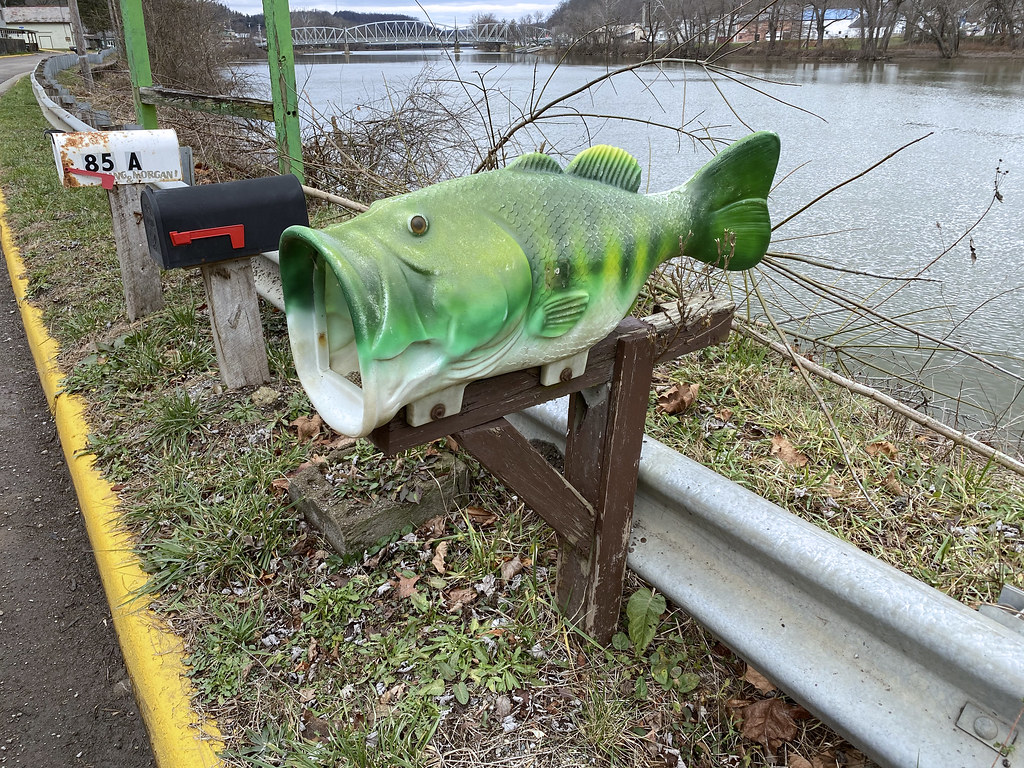
OH Malta - Mailbox by Ken
Via Flickr:
Fish mailbox in Malta, Ohio.