


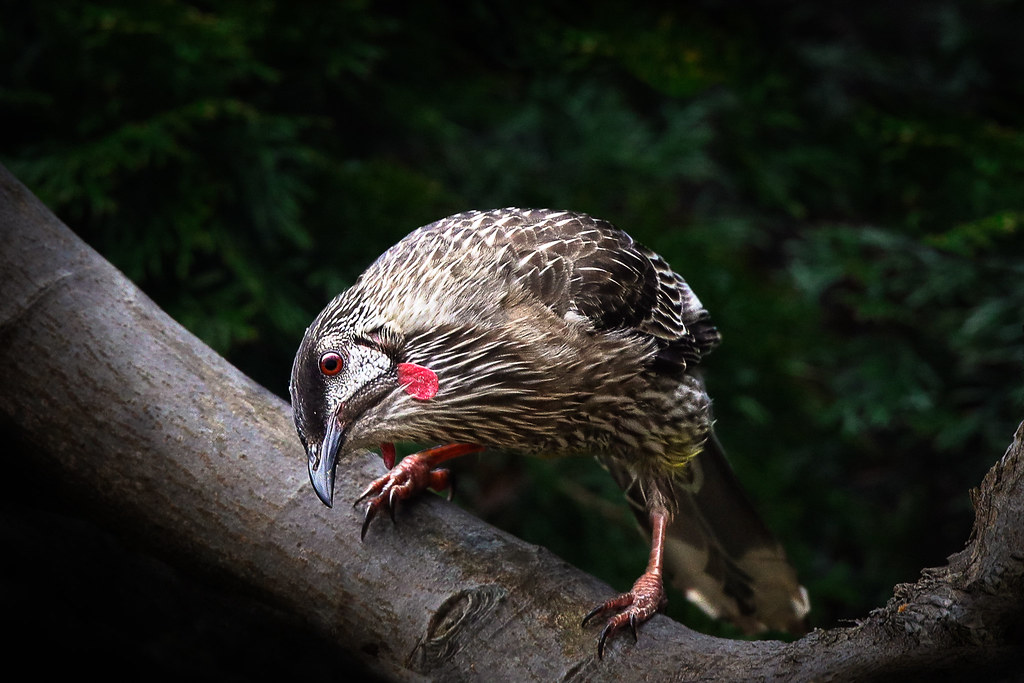
Curious Red Wattlebird by Graeme O'Rourke Via Flickr: This photo was captured in my backyard as this red wattlebird was perched in my Japanese Maple tree. Over the past 12 months it has learnt to trust me and this display I can only put down to this bird trying to ascertain if it was really me behind the camera as the very next capture shows it in a similar low-down pose, but this time looking from its left side. . .or maybe it was checking the brand and model of my camera. It is one of the largest nectar-feeding birds in the world and is the second largest species of honeyeater native to Australia, eclipsed by the yellow wattlebird which is found only in Tasmania. The red wattlebird has a long, specialized tongue to extract nectar from flowers. Its tongue can extend well beyond the tip of its bill, and it is divided at the end to form a brush-like structure with over a hundred bristles that soak up nectar by capillary action. The red wattlebird has mainly grey-brown plumage, red eyes, distinctive pinkish-red wattles** either side of its neck, white streaks on the chest and a large bright yellow patch on the lower belly. The male and female have similar plumage. (**A wattle is a fleshy caruncle from various parts of the head or neck in several groups of birds and mammals and those on the red wattlebird dangle from the lower rear corner of the ear coverts on either side of the neck.) The species is found in southeast Queensland, NSW, Victoria, South Australia and in the southwest of Western Australia, in open forest and woodlands, and is a common visitor to urban gardens and parks. Loud and conspicuous, the red wattlebird is generally found in trees, where it gets most of its food; occasionally it forages on the ground, feeding from a wide variety of flowering plants. Insects also comprise part of its diet. It is territorial and at times aggressive towards birds of other species, often defending rich sources of nectar. Breeding throughout its range, the red wattlebird builds a cup-shaped nest in a tree and raises one or two broods a year.