Hevel (Ecclesiastes 3:1-8) takes a passage from biblical poetry and uses the text as a series of prompts with which to tell stories about a community over time.
ive been really loving another bullshit night in suck city lately. the authors memoir about his deadbeat father. some of the mild whimsicalities of the story (his father's dummy corporation, the Fact Foundation of America, in particular) remind me a lot of kurt vonnegut in the way that cherry by nico walker also reminded me of kurt vonnegut (vindicated upon a direct namedrop in that one!!). the im-not-mad-im-just-observing of it. i love books like this. i love somebody looking at a dreary personal trauma and mulling over it for a few hundred pages. i love human stories. i suppose thats how id put it. i have my thing against genre fiction and i think its similar to my preference for dreampop over hyperpop. too stimulating. im of course a highly reflective person. i imagine it comes through in my blogging. i love learning and thinking about how it is to be alive
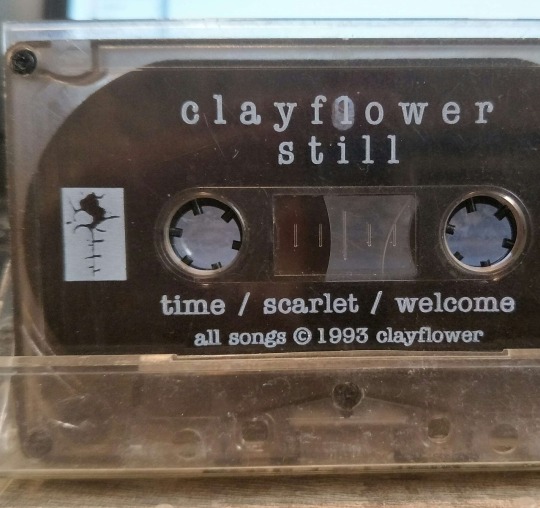
Final info ive put together after i have just looked over the insert notes (inside the other tape) sent to me by my friend:
This band had Steven Wells and Andrew Bain in it - they went on to be in a pretty popular NZ rock band called Fur Patrol from late 90s-2000s, so this is a precursor to that. in the notes they also thank Campbell Kneale, a prolific underground nz musician in bands like Birchville Cat Motel and Black Boned Angel. they also thank "Drinkwater".
alright everyone. after 33k+ notes on an obscure 90s indie song from Aotearoa i gotta admit many want to hear the rest, & as i cant think of a better format to supply this, here's the rest of the tape in this post. please let it stay here where it needs to be, don't spread it like its yours. its not mine either!
i now present to you:
Clayflower - Still (1993, Aotearoa, Cassette, Shoegaze/Indie Rock)
beautiful and cool obscure music like this is everywhere if you just wanna look for it even for a few minutes. dont let yourself think someone has to come along and show it to you <3
Alright, I have a weird one. Are there any TTRPGS that revolve around Coral? That, or have coral as an important element of the game?
Oh my gosh my ask box apparently ate this for MONTHS and finally decided to spit this back. Let's see what we've got!
THEME: Coral
Descent into Midnight, by Rich Howard, Taylor LaBresh, and Richard Kreutz-Landry.
At its heart, Descent into Midnight (DiM) is a game about community, family, and hope. It's a tabletop roleplaying game that takes place in a technologically advanced aquatic civilization whose culture has never been touched by humanity. Bioengineering and psionic, or mental, powers allow the strange and varied species to communicate and interact with their surroundings no matter their physiology.
In the game, players take on the roles of guardians, defending their community from a physical, emotional, and even existential threat. The game focuses on the relationships between the guardians, the inhabitants they protect, and their internal struggles and dreams in the face of a corruption that threatens to change their world.
You can play as whatever you like in Descent in to Midnight, including fish, plants, even abstract concepts - so a shelf of coral isn’t really that much of a stretch. The playbooks (yes, playbooks, this is a PbtA game) are centred more about your personality, and what you look like is secondary. The game is designed to take a turn for the darker before it pushes towards hope, so I think your game experience will be different depending on whether this is a one-shot or a long-form campaign.
Delve Deeper, by Maik.
A complete new game of under-oceanic adventuring and exploration.
Play as intelligent oceanic folks such as the cephaliin octopoids, the crustaciin crab-folk and the fish-like merfolk and explore the coral reefs, open seas and abyssal trenches in search for adventure, pearls and treasure.
You don’t play as coral in this game, but you’re certainly exploring it! Taking nods from games such as Troika!, Electric Bastionland, and Brave Zenith, this game feels solidly inside the OSR camp, but with a special love for the wacky and weird. If you want to have a particular connection to the coral reefs, you’ll likely want to play as a Merfolk, who build cities from the coral and rule as a matriarchal society. This game is full of lore, but not extensively so - it’s only 33 pages long in total. But I think you’ll probably come away from reading Delve Deeper with a pretty strong sense of what this underwater kingdom is like.
Reefs of Despair, by Zaftikat
You are a sea anemone, stuck firm in an ocean that will soon be inhospitable to you. Grapple with climate change as you explore fatalism and ennui.
Sea anemones aren’t coral but they’re kind of close right?
Now this game is neat. It uses popcorn as a resolution mechanic - how cool is that? You have to pop the popcorn in a stove-top vessel, rather than a microwave, because you have to count how many popcorn kernels pop at first pop - the more there are, the better your outcome. Apart from that, your character has two stats: Ennui and Fatalism. These stats rise and fall similar to the way stats raise and fall in Honey Heist - with a similar outcome if you get too high or too low, by ending the game. There’s also a third end state for what happens once you’ve popped all the kernels, but I’ll leave that one for folks who decide to download this game and read it.
The game also is donating proceeds to the Coral Restoration Foundation, so in a roundabout way, I guess it was about coral all along.
Other Games You Should Check Out
Bones Deep, by Technical Grimoire. (You should really check this one out.)
really struggled with this one and I think it shows. but I hope you like it. CW: narcissism, non-negotiated bdsm, 4k words and almost no actual sex, extended hopeless captivity, cringe
she doesn't know what she looks like anymore; she lives in the dark. real darkness, not the filtered gray of her own bedroom at night, or the dim red of closed eyelids, which feels like nothing until someone steps between you and the window and it darkens further. her cage is wrapped in layers of heavy, dense-woven cloth, and nothing makes it through. and when she is let out, it's into a room with blackout curtains swallowing the windowframes, electrical tape over the LEDs of his computer, rubber strips sealing the edges of the door to the hall.
when it first arrived, the realization that she could no longer picture her own face produced an unexpected feeling: a small and deeply unfamiliar joy. you wouldn't think it would be worth it, and it's not, but she's been a little high ever since. it's been weeks and still, whenever she reaches for it, there's a frisson as her mental grasp closes on nothing. like a string around her ankle, which she had never been able to untie, suddenly coming loose on its own. it doesn't let her fly—she hasn't been made beautiful—but she can run and jump for what feels like the first time. a faint taste of beauty, maybe; the free trial. it's an emotion (she imagines) few have felt. and it's something she could share with him, something new that he didn't arrange. she hasn't yet, though.
---
the first time she came over it was, you know, normal. for downtown, anyway. high up and spacious, expensive smart appliances, a fractionally-dressed anime girl on a poster on the wall. a low platform bed that looked like just a mattress on the floor at first. lights off but midafternoon sun coming through the blinds. the warm, soft light gave everything an air of comfortable familiarity. she recognized the room as an instance of the general type and the details got quickly flattened out. the plastic girls on the shelf, their unique permutations of poses and outfits and hair colors, were compressed into the phrase "anime figurines," and that was the last she saw of them.
the one moment that stood out didn't do so all that much, really, but she's built it up, revisiting it, so that now it's the basis for almost all her memories of how the room looked. the bed was next to the closet and when he left her alone for a minute she felt drawn to look inside. there was a pile of clothes at one end, a shelf crammed with cardboard and plastic at the other. and in between, lying on the carpet, there was an undecipherable shape, pale and pink. she quickly looked away at first, out of an instinctive politeness, without recognition. it was a half-scale limbless torso; the shoulders were missing, leaving a surreal peach taper to a headless neck above the tiny breasts. there were the beginnings of thighs, enough to give shape to hips and buttocks, though not enough that they'd get in the way of the single, resolutely non-skeuomorphic orifice between them. they ended, like the neck, in more smooth unbroken skin, with the edges gently rounded off of the stumps. something induced her to touch it; it was a silken silicone, a trace of lube crusted on the neck. her fingers slid off. she heard the toilet flush and jerked back, crawled back across the bed. when he rejoined her she was contemplating his bong.
nothing else particularly memorable happened that afternoon. she liked him; he paid attention to the way she moved, and commented on gestures and expressions she had put a lot of work into. there was a little bit of an edge to his scrutiny, like he was making fun of her, that she took as a good sign. he'd asked her to put her hair in twintails before she came, and she'd obliged. they got pleasantly high, he hit her some, she sucked his dick; he called her a slut, and came in her hair, which was annoying but precedented. she felt real, on the rush hour bus back home. partaking of more dimensions than usual, in a way that only good dates let her. but she's had good dates before; it was nothing that would keep the room sharp in her memory. now, though, she wishes she had taken more notice of it. not because it would somehow help her escape; she doesn't really think about things that way now. it would just be comforting to have more of a mental image of the place. it would help her be less scared of the dark.
---
she used to be claustrophobic. as a child she'd bruised her arms and strained her neck and occasionally broken the doors in her panic to get back out of the chests and cabinets she kept compulsively shutting herself up inside. but that's not really her problem anymore. now she thinks of the cage as a relief; it's bounded, known. the bedroom is unsettlingly large and empty by comparison, with its too-many cageworths of space in which she feels at risk of getting lost.
she doesn't have to face it often, though. he doesn't even always lock the cage during the day anymore, but she doesn't have to go out when he leaves for work. she can just stay there and listen to the tick of the clock. if he leaves the air filter running, there's that too, and if not, there's traffic noise. sometimes there's rain. and all the sounds of life when he comes home: the door opening and closing, steps across the floor, soft on the carpet. the keyboard, the computer fan, breathing, farts. it's all muffled by the fabric, which lends it an interesting distance, like reading a transcript. he uses headphones and no light from the screen makes it past the cage cover, but she can tell when he's watching something by the way his sounds settle like dust at that end of the room. sometimes he hums along to music, or bounces to the rhythm with the chair creaking in time (or, she supposes, some fraction of a beat behind). sometimes he jerks off.
but sometimes there's the rustle of the cover being rearranged and the rattle of the latch close to her face and he brings her out into the wider dark. mostly it's to take her outside the room, which is even worse. she clings to him a little bit whenever he leads her across the hall (light off, cold rushing at her from the far end) to the bathroom (windowless, not even a glint in the mirror). being able to touch and hear him only makes the gap on her other side quieter and emptier. and it doesn't smell right. but occasionally—she tracks it obsessively, looking for patterns, trying and always failing to find support for any theory more complex than "about once a day"—he drags her over to the bed instead, presses her into it. his weight makes it feel almost safe, like she's not exposed. when she's lying out in the open and he's not on top of her she gets almost dizzy, like the bed is tilting and she's going slide off and be left drifting with nothing to hold onto, or push off of.
---
the second time she came over it was night, and his room was darker, only city lights through the window and hentai playing on his monitor. presumably for ambiance. but that was fine, maybe better. she didn't want him to see her body in any detail, particularly. she'd kept the twintails and added makeup, but it seemed like the silhouette was enough for him. she got less-pleasantly high and was distracted most of the evening by an urgent uncertainty about whether the modulation of her whimpers encoded all the details of the sensation of his hands feeling her up, and whether it ought to. he had asked her to make more noise—"cute noises"—and they didn't come instinctively, but it seemed plausible that if they did she would naturally use them to reflect exactly what he was doing to her, losslessly transposed into the pattern of her squeaks and gasps. it might be important for realism. "you're a hot little bitch when I don't have to look at your face," he told her while she was moaning into a pillow, and his dick replaced three fingers in her ass. she thrilled at the words. she didn't want him to think she was ugly, either, not exactly. but it felt promising.
can you see me? she wondered. she didn't say it aloud, but the question echoed in her mind for what seemed like a long time, and she thought it might be leaking into her whines in an obscure encoding. she'd always previously considered compliments on her appearance to be, at best, a sign that the speaker simply wasn't paying attention. she was a projection, the shadow cast by someone actually hot and interesting and real on the world. or like a crystal dangling from a windchime, which occasionally caught the light of beauty and elegance, by accident. her head hadn't stopped spinning since he pushed her onto the bed, which felt like an hour ago, and she pictured the pieces of the windchime spinning wildly along with her. if you looked at a glittering piece of glass and thought it was the sun you were an idiot. this felt so obvious to her that it was exasperating when her partners seemingly couldn't see it. sometimes, though, with certain guys, and when she was tired and suitably disoriented, she thought she could see their gaze shift as if the other were sitting next to her on the bed.
he was fucking her hard. high, she felt it mostly as the pressure holding her down and an uncomfortable twinge where the head of his dick pressed against the end of her rectum and an indistinct, suffusing ache of overstimulation. it was hard to think and she couldn't exactly track his gaze while facedown on the bed. but she felt the conclusion trickling into being regardless: that he could see the light she was reflecting, could tell she was just the ghost of someone better, that he knew which one of them he liked and it wasn't her. but that too was fine, or maybe better; as long as she was the means of access to that living self.
---
often when he speaks to her now it's purely instructions. even those have thinned out since the beginning; she no longer needs to be told to come out of the cage or get in at the appropriate times. she still needs verbal cues to rearrange herself on the bed for him, but fewer as she learns to read him by pressure and breathing. sometimes he just talks, though, narrating to her a train of thought that occasionally brushes up against her in familiar ways (how good her skin or mouth or ass feels, how much he likes not having to see her) but mostly wanders much more widely (work sucked, there was a hot girl on the bus, a new machine at the gym, the new anime season). she doesn't say much in response and he never seems to expect it. she just listens, uniformly eager to drink up his words.
she used to talk to herself, not in the first few weeks but for a while after that. she worries, though, that if she does it too much she'll quickly come to rely on it, and soon she'll be muttering her thoughts the whole time she's waiting for him to take her out, and murmuring herself to sleep after. which would probably bother him. so she tries not to even want it. it feels fair, kind of, that for all the effort he's put into setting everything up so precisely, that it should work out exactly how he wants. she thinks that maybe her thoughts did drift off a while ago, into that wide open space. not that she's crazy, just that she doesn't have anything to push or pull against anymore. but maybe that's all the more reason not to talk to herself, actually? if hearing a voice would make her feel anchored, even though she's not?
---
when he introduced the cage, she'd been sleeping over a couple nights a week. sometimes he liked to cuddle her through the night, but other times he pushed her out of bed to sleep on the floor, and without a blanket she was restless and she always woke up sore. so the cage honestly felt like an upgrade—there was some sort of padding on the bottom, and a blanket she could pull over her. it was nice to have a place. his apartment was messy but things he cared about had dedicated shelves or corners; she liked being one of those. the toy she'd noticed the first time was tucked away somewhere now; the middle of the closet was fully taken up by the cage. that first night he showed it to her, he put her away in the closet after coming in her ass, then pulled her out in the morning for oral. she reflected on the satisfying tidiness of this arrangement while lying in his bed as he showered and dressed for work. but she was already thinking about the bus home by the time he came out. "could you turn on the light? I need to find my clothes."
"no." exasperated, falling pitch; you have to ask? his scorn was so fierce that it didn't even occur to her to argue. "get back in there." only once she had and he'd closed the latch did she think of something to say. "I need to leave soon though—" but he interrupted: "I'll be back later today. you've got a protein bar and a water bottle." she checked; she did. "and you got to use the bathroom this morning?" she nodded, then said "yes" when she realized he couldn't see her. "then you should be fine. I set up the mic so in an emergency you can yell for me and I'll get a notification. don't bother the neighbors." the closet door slid shut, and the darkness became absolute. the bedroom door clicked closed, and she was alone.
he did come back, and found her where he'd left her. she'd tried to get out, obviously. but the long sides of the cage were almost flush with the wall and the closet door, and the short ends were stronger. it hurt to push against the wire, and the blanket would only cover one end at a time. once her limbs started to cramp, she decided to wait—except, once he was there again, it seemed just as hopeless to try to get away. even when he let her out so she could pee, holding her arm but only lightly, she couldn't envision pulling away without stumbling and falling. so she didn't. and then she was back in the cage.
and that was how she moved in. kidnapped, technically, in a way perceptible only in retrospect. she's tried to muster feelings other than a sort of detached acknowledgment, but that's mostly all that's available. any eroticism in that description is so attenuated, the actual sex amortized over endless hours of crouching in the quiet dark, nibbling on the weird dry cookie things he gets her, that it doesn't really factor into the overall assessment. there's a little bit of guilt, gratitude ingrown and infected. and a persistent worry: a real person would resist, prettily; struggle harder, though of course in vain. and she doesn't, despite her worries; another reminder of that gap.
---
he was scrupulous about locking the cage for a few weeks, but the first time he forgot she went the whole day without opening it. she couldn't articulate an actual reason, just that—the first day, when she'd strained against the cage and it didn't bend, she'd had to quickly shift her body into a configuration that didn't press so hard against it, to not trigger a panic attack. and the mental equivalent, it seemed, had manifested as a sort of determination to play the hand given to her, not to try to reject it. having a choice to debate made the time spent waiting much more bearable, anyway. but when he didn't come home, and the tide of the rush-hour traffic had receded into the intermittent whispers of individual engines, signaling the late night, she gave in to impulse—lifted the latch, crawled out, opened the doors one after another.
the whole place was dark, and out of some superstition she didn't look first for a lightswitch. instead she felt her way along the hall into the cavernous void of the living room; hesitated, feeling the empty space, then started searching for the front door. it was locked. from the outside. she didn't think you could do that? only when she'd scrabbled at the handle for a moment did she try for the switch; it was right by the door, but didn't work. later, she realized the lights, and maybe the lock itself, were probably controlled by his smart home system, but in the moment it was inexplicable; the world conspiring to mock her helplessness. she twisted and poked at every part of the door and frame she could find before sitting back on the floor in bafflement. she was very hungry and it was making her petulant about her failures—everything was difficult in the dark, and unfamiliar things doubly so—and slow to think of anything else to try. and touching the doorknob had made her aware of her nakedness, adding another layer of hesitation to the thought of opening the door. and so before long she made her way back to the bedroom, carefully closing the doors behind her, and curled up in the cage again to try to sleep.
she's rehearsed the story of her attempted escape endlessly, by now; it's turned into a recurring daydream, a reverie she revisits almost daily. she's kind of glad, in retrospect, that she couldn't leave. when she pictures the alternative it almost always leads to her having to explain to someone what happened. even if she didn't, she would always have the option to. and she can't imagine the right audience; a way in which possession of the story wouldn't inevitably be a threat against him. in a way that power is already present, latent in the possibility of someday leaving. she doesn't like to think about it. it's relaxing to instead think of the insurmountable obstacles she faced and failed to overcome, and the comfort she was able to return to. he did come home that night, after all, drunk and energetic—not drunk enough for whiskey dick, a little too drunk to give coherent instructions; he ended up jerking her around a lot. the daydream always spirals towards that moment, where the memories drain away and it just becomes a fantasy. it was a milestone—the last time there was any light (he hadn't closed the bedroom door) while she was out of the cage.
---
he doesn't really ever hurt her. he pulls her around, sometimes roughly, like he did that night, and sometimes it hurts. but he doesn't hurt her deliberately; doesn't slap her like he did on the first date, even when she wishes he would. it would be grounding, she thinks, to have that feeling of touch that lingers past the actual contact. it's impossible to say whether it's because she's operating flawlessly, with no need for adjustment, or if she doesn't interest him enough to be worth correction.
he didn't use to keep the place in such hermetic darkness, is the thing. there was nothing stopping him if he'd wanted to, but he didn't. so it seems like it all must be for her, which makes her squirm against the cage floor in a sort of suffocating shame. it's not a new thought, just one so uncomfortable she keeps returning to it. makeup would've helped with that, before. something to make her feel like she's less in the way when he's trying to look past her. she doesn't like how it feels on her skin, though, which is why she only ever used to wear it for dates. and now, obviously, there's no point. even if it weren't for the dark, or the cage, there's no one around to appreciate it. he hasn't come home yet, but again, the fading of the traffic lets her know it's late.
suddenly she's filled with the urge to check her reflection, in a strange hope that months in the dark have changed it. it doesn't make any sense, even to herself, but once the idea is in her head it's hard to resist. after all the time she's spent floating, maybe she's drifted into something closer to what he wants. she can't turn the lights on, but from the balcony she might be able to see herself in the glass of the sliding door. so once again she makes her way carefully down the hall and into the living room. she gingerly circumnavigates the couch and parts the heavy curtains that hide the glass door to the balcony.
the view is honestly underwhelming. she'd vaguely expected to be struck dumb by the glory of the heavens (she can see the full moon, even) and the glittering skyscrapers, after so long. and it is bright; she's frozen squinting at the floor for a moment. but the light is mostly diffuse, filtering up from street level, even and shadowless. instead her reaction is just pure status thrill. you never see the sun because you're locked in his suburban basement. I never see the sun because I'm locked in his high-rise apartment. we are not the same. but the sliding door isn't locked, and she steps out still naked onto the balcony. realistically she's almost certainly just as unobserved as she was in the cage but the sense of shame rushes back quickly. it only adds urgency to her mission, though. she leaves the door open, just steps to the side to look for her reflection.
she doesn't recognize the whir of the lock at first, with nothing but the empty space of the living room to separate her from it. so she only notices his arrival when the door actually opens and it's too late to hide what she's doing. he sees her right away, and crosses the room, unhurried, as the front door closes behind him.
"I just wanted to see if I was pretty." something, maybe an infinitesimal increase in his pace, prompts her to add "for you! I wanted to be pretty for you!"
she was fine when she was looking out from the balcony. it was only when she looked inside that she was overcome by vertigo. she's stumbled back through the door and fallen to her knees in front of him on the living room floor. he crouches too, taking her hands in one of his. he's slightly illuminated by the faint light from the still-open sliding door, but she's still looking at the floor to steady herself.
"hey." she raises her head, and immediately regrets it. "you stupid—bitch—" and he hits her harder than she ever has been. "of course you're not."
she's already shivering. "I'm sorry, I know, I just."
he's gripping her arms and shaking her and she can't go totally limp because whiplash but she's trying to resist as little as possible. rather than wishing he'd stop she wishes he wouldn't do it here, in the open, where everything still feels unstable. there's a building sensation like she's going to overflow somehow, like a shaken soda can; bubbling over with tears or vomit or some more insubstantial emotional fizziness. it's percolating though her skin as a sharp prickle everywhere he isn't touching her, not fast enough to relieve the pressure—and then he stops and lets go and she folds over. it's tears after all, and words spilling out much faster than she's used to: "I'm sorry I'm so sorry I'll be good I'll be good I'll be good I'll be good."
it's barely recognizable to her as speech, let alone as her own voice. something in her is frantically sorting through a jumbled bin of sounds, searching for ones that will appeal. that part wants to win; to find the shortest sequence of words that will return his grasp to her arm, so that secure tether can reel her in and back to the safety of the bedroom. but she mostly feels like a spectator. she's watching as frantically-assembled offerings are thrown into a fire, where they form beautifully intricate curls of smoke. she'd be in no hurry to stop it except that she doesn't know what will happen when she runs out. it's not her strong suit at all, though, begging. her voice gets so gross when she's crying.
"okay, shut up." she does. "go close the door, and then get back in your cage." it's still hard to tell if he's mad, but his voice at least sounds calm. like things can be normal again. whatever her many flaws, at least they're not obscuring that actual defiance isn't one of them. she gets up, slides the door shut and draws the curtains, vanishing.
read the story that critics are calling "like the porn version of 'there's six guys who live in this flat and all they do all day is play WoW and watch movies'"
The thing you have to understand about The Florida Project — before you can understand anything else about it, before the sad-children-in-the-shadow-of-Disney reading can even begin to do the work people want it to do — is that the land the Magic Castle Motel sits on was specifically the land Walt Disney didn't buy in 1964, and the reason for both halves of that sentence is the same reason, which is that Walt Disney was engaged in what may be the single greatest private real estate acquisition in American history and he was doing it using shell companies.
The story is that in 1964 Disney sent a handful of lawyers and bag-men to Central Florida with instructions to buy up as much contiguous land as they could, quietly, through a rotating cast of fake corporations with on-the-nose names — M.T. Lott Real Estate Investments, Ayefour Corporation, Bay Lake Properties, Reedy Creek Ranch Lands — and with strict orders that the name Disney not appear on any document, any check, any filing, anything, because if the sellers figured out who the buyer was the price per acre would go up by an order of magnitude that afternoon. And it worked. Walt picked up roughly 27,000 acres of swamp, pine scrub, and exhausted citrus land straddling the Orange–Osceola county line at something like two hundred dollars an acre, which even in 1964 dollars was cheaper than the dirt had any business being, and when the story finally broke in late 1965 and the Orlando Sentinel figured out who had been buying the entire lower-middle part of the state, the remaining parcels around the edges of what Disney had already assembled shot up to nowhere in the space of about a week.
And everything around Disney — the entire US-192 motel strip the Magic Castle sits on, the entire tourist corridor from Kissimmee west to the park gates, every single purple and cyan and flamingo-pink mid-century-moderne motor court whose sun-faded carcass Sean Baker used as a location — is sitting on land that was somebody's late-arriving, post-reveal, high-priced consolation prize. You couldn't get a piece of what Walt got. You got a piece of what Walt left behind, and you paid more for it, and you had to build something that would extract value from the proximity to the park without being inside the park, because inside the park was off the table.
This, institutionally, is called "agglomeration without spillover." Normally when you build a major regional attraction you get a ring of tax base around it — restaurants, hotels, retail, services — and that ring shares in the value the attraction creates by capturing a fraction of the visitor spending, and the local counties tax the ring, and the ring supports public services that support the attraction, and everybody's incentives are at least nominally aligned. Disney did something specific to avoid this. The Reedy Creek Improvement District, chartered by the Florida legislature in 1967, was a quasi-governmental entity carved out of the Orange and Osceola county maps that functioned as Disney's own private municipality, with its own building codes, its own fire department, its own utility authority, its own bonding power, and effectively its own police. The district's board was controlled by Disney landowners. The district's revenue went to Disney infrastructure. The district's tax base did not contribute to Osceola or Orange County services in any meaningful sense.
Which means the ring around Disney — the Kissimmee motels, the US-192 t-shirt shops, the souvenir warehouses, the low-wage service infrastructure — got all of the externalities and none of the tax revenue. The kids on US-192 go to Osceola County public schools. The Osceola County public schools are funded by Osceola County property taxes. The single largest property owner in Osceola County pays its property taxes to itself, through Reedy Creek, to build its own roads and maintain its own fire hydrants. This is not a secret and it is not contested, it is the explicit legal structure the state of Florida agreed to in 1967 because Walt had made it clear that without this structure there would be no park, and the state of Florida in 1967 was desperate enough for the tax base to make a deal that would, seventy years later, produce the specific conditions inside of which Moonee's mother would be trying to make her weekly rent.
Now, the motels themselves. US-192 was not originally built as emergency housing for the precariously-employed working poor of the Greater Orlando service economy, it was built as mid-market tourist infrastructure for the 1970s and 1980s middle-class American family driving down from Cleveland in a station wagon to take the kids to the Magic Kingdom, and the motels were built to that price point and that aesthetic. The purple paint, the neon signs, the "Futureland" and "Arabian Nights"-type theming — that was meant to catch the eye of a family doing sixty miles an hour on a four-lane trying to decide where to stop for the night, back when the only on-property Disney hotels were the Contemporary and the Polynesian and everything else was off-site.
Then the 1990s and 2000s happened. Disney kept building on its own land — the Caribbean Beach, the Port Orleans resorts, the All-Star Value Resorts, the sprawl of Disney-operated hotels in the thousands of rooms — and the off-property motels on US-192 got undercut. The All-Star Music Resort is a Disney-branded budget property inside the bubble, on Disney transit, with Magic Bands and park integration, for not that much more than a room at the Magic Castle, and once Disney built it the calculus for a visiting middle-class family changed permanently. You could stay in the bubble. You no longer had to drive in every morning past the Walgreens and the Winn-Dixie and the souvenir warehouse with the giant orange on the roof. The 1980s motel's entire business model was "we are what you can afford and we are close to the park," and that business model died the moment Disney figured out it could be what you can afford.
So you had a whole inventory of purple tourist motels on a four-lane highway with collapsing room rates and declining maintenance budgets, and you had — in Central Florida, in the 2000s, accelerating dramatically after 2008 — a population of service workers and evicted families and people whose credit would no longer pass a normal apartment application, and the match between those two things was the invention of the extended-stay weekly-rate motel as de facto low-income housing in Florida. Which works for a very specific reason that the movie never explains and assumes you understand, which is that in Florida if you rent by the week and stay fewer than twenty-eight consecutive days you are legally a hotel guest and not a tenant, which means the motel can evict you at any time for any reason or no reason without going through the eviction courts, and you in turn don't need to pass a credit check or produce references or put down first-last-and-security to move in, you just need this week's cash.
This is the apparatus Halley is navigating. Every Friday she has to put together roughly two hundred fifty dollars in cash, and if she can't, Bobby can put her out on the sidewalk with her daughter and her belongings by Saturday afternoon without filing a single piece of paper. This is also why Bobby moves families between rooms every month or so, which the movie shows and doesn't explain — it's to reset the twenty-eight-day clock, so nobody can claim tenant status, so the legal machinery stays on Bobby's side, so the motel can keep functioning as what it is rather than becoming what it would be if the state of Florida required it to function as actual residential housing, which it cannot financially support and is not structurally equipped for and its insurance doesn't cover.
Bobby. Willem Dafoe as Bobby is the most important structural figure in the movie and people keep misreading him because the Oscar clip was the scene with the pedophile and everyone got fixated on Bobby-as-protector, which is fine, he is a protector, but what Bobby actually is is the middle layer of an institutional pattern that has no good name. He's not a landlord — landlords in the Florida statutes have specific duties and rights and Bobby doesn't have most of them. He's not a social worker — social workers are trained, licensed, and supervised, and Bobby is not. He's not a cop. He's not a therapist. He's the guy with the keys and the walkie-talkie who is, in practice, the last institutional backstop between the families at the Magic Castle and the actual street, and he's a private employee of a private motel operator whose business model is marginal and whose tolerance for his interventions is finite.
Bobby is doing social work without the training, the funding, the authority, or the backup, and the reason he is doing social work at all is because the state of Florida has, for forty years, been making a specific set of choices about where the tax base from Central Florida tourism flows, and a specific set of choices about the rental regulatory environment, and a specific set of choices about the Medicaid expansion and the TANF regime and the housing voucher program, and the downstream effect of those choices is that when a family like Halley's runs out of legitimate options the last option is a motel manager on US-192 who has to decide every week whether the kid on his property is in enough danger that he needs to involve the state, knowing that if he involves the state the kid gets taken.
(This is the choice he makes at the end of the film, and it is not a dramatic choice, it is a bureaucratic choice, and the movie is careful to let it be bureaucratic.)
What Baker is doing, across his filmography — and I'll be brief about this because I've been on about it elsewhere — is documenting a very specific American economic layer that doesn't have a good name in public discourse but is in fact the entire substrate of several American industries, which is the service-and-adjacency labor pool around the big private entertainment and tourism sectors, and the informal housing and care arrangements that pool generates because the official labor market doesn't pay enough to support regular housing and the official housing market doesn't have enough inventory to house the people who work in it. The Florida Project is the cleanest statement of the thesis because the metaphor is built into the geography. You literally cannot film it without filming it — the motel is a mile from the park.
Which brings me to the temporal rhyme, because this pattern is not new and it is not unique to Disney. Resort economies do this. The Catskills did it, the Jersey shore did it, Atlantic City did it in its second act — the periphery labor pool that services the glamour core cannot afford to live in the glamour core, so it lives adjacent in a shadow inventory of housing stock whose entire economy is structured by the glamour core's wage ceiling and land prices. Mining towns did it harder, because at least mining towns had the decency to be explicit — the company built the housing, the company owned the housing, the company took rent out of your paycheck, and you lived in a company town. The late-twentieth-century resort pattern is a company town without the company taking responsibility. The labor pool is there, the substandard housing is there, the shadow economy is there, but ownership is distributed across a hundred small operators and the actual beneficiary is a mile away behind a moat and a monorail, and when you ask the beneficiary what they're doing about it the beneficiary says "we're not in that business." Which is technically correct. They are in the business of hiring the labor that lives in that housing at a wage that makes that housing the only option, and they are structured as a special legal district that does not contribute to the public services that housing relies on, but they are not, in a literal sense, operating the motel.
The Hollywood studios did a cleaner version of this in the twenties and thirties, which is maybe the most useful parallel because it happened on similar geography — the San Fernando Valley's development as a bedroom community for studio crews and extras was explicitly subsidized by the studios in some cases, and the specific wage ceilings of non-contract crew labor produced a specific housing type (the single-story stucco bungalow with the detached garage) that is still visible from the air when you fly over Van Nuys. The difference is that by the fifties and sixties Los Angeles at least had the public infrastructure — transit, schools, annexation of incorporated areas — to absorb the periphery population into something resembling a functioning metropolis. Central Florida never did that. Central Florida grew up after the mid-century, in the Sun Belt expansion period, under a set of state-level political and tax regimes that were specifically hostile to the kind of metropolitan integration that Los Angeles got. Orange County and Osceola County did not build the transit, did not build the schools, did not build the public housing, did not build the medical infrastructure, that would have been required to support the service population Disney's presence was creating. Instead they collected what property taxes they could from the non-Reedy-Creek parcels and hoped.
This is how you end up with Moonee. Not through the malice of any particular actor and not through the failure of any particular program, but through the compounding effect of a set of institutional choices made at the state level between 1965 and about 2005 that each, individually, looked reasonable to the people making them and that collectively added up to an environment in which a bright, funny, healthy seven-year-old child lives in a purple motel a mile from the happiest place on earth and her mother turns tricks in the bathroom while the child watches YouTube in the parking lot. The movie is not making an argument about the moral failure of anybody in the frame. It is showing you the set of conditions, patiently, at length, at kid-height, and it is trusting you to work out that the conditions are the argument.
The title is doing some work, too, obviously. "The Florida Project" was Walt's internal code name for what became Walt Disney World, during the acquisition phase — the blueprints and the planning documents all say "Florida Project" because anything that said "Disney" would have tipped the price. The movie's title reclaims the phrase and points it somewhere else. This IS the Florida project. The kids are the project. The motel is the project. The service labor force living on US-192 in tourist-bait mid-century motor courts that the company town couldn't be bothered to build because it got a better deal by not building them — that is what Walt's Florida project actually produced.
And the ending, which people have been arguing about since 2017. Moonee gets found by child services, who are about to take her. Jancey — her one real friend, the neighbor kid — grabs her hand and runs, and the movie follows them, and the camera suddenly switches from 35mm to iPhone and the two of them are sprinting through the gates of the Magic Kingdom down Main Street toward the castle in the lowest-resolution consumer-grade footage imaginable, a formal rupture so violent that it reads almost like an error in the print, and that is where the movie ends. The reading I find most persuasive is not the "is it real or is it a dream" reading, because the formal rupture forecloses that question — the film has already told you by changing cameras that this is not of a piece with what you have been watching. The question is not whether it happened. The question is what the iPhone means. And what I think it means is: this is the only format in which Disney is accessible to these kids, the unlicensed illegal guerrilla stolen shot from the fan's pocket, the footage that didn't require a permit because no permit would ever have been issued, the dream in the resolution that the dreamer can afford. Baker couldn't get shooting permits inside the park, so he shot it guerrilla on a phone, and the guerrilla iPhone becomes the thing itself — the last shot of the movie is exactly as much Disney as the characters will ever have.
Which is a formal argument, and it's sitting inside a geographic argument, and the geographic argument is sitting inside an institutional argument about a fifty-year-old real estate shell-company play and the tax district that got chartered to protect it, and all of that is sitting inside two children running, which is what the movie wants you to see first and last. Same as it ever was, basically, just with better signage.
I just discovered this band and I'm obsessed. This song is a straight-up bop, and I want to be friends with all these people. So much to enjoy here. The old dude who sets the rhythm by banging a branch on a big tree root, the guys shaking their booty in grass skirts, the two gorgeous guitarists (maybe father and son?) all focused and in-the-zone, the two women playfully dancing and singing at each other... I love it all.
Their Bandcamp is here, check it out:
Orchéstre Baka Gbiné are Baka musicians from the Cameroon-Congo border, deep in the rainforest.
Using guitars, percussion, voices and dance