Years ago, when I was updating semi-regularly, I often had an annual theme to what my practice and research would focus around. It was a collaborative effort between what I was interested in researching at the moment and what the gods were pointing me towards through divination and serendipity. Sometimes I would know the theme by January, and other times it wouldn’t be until late into the…
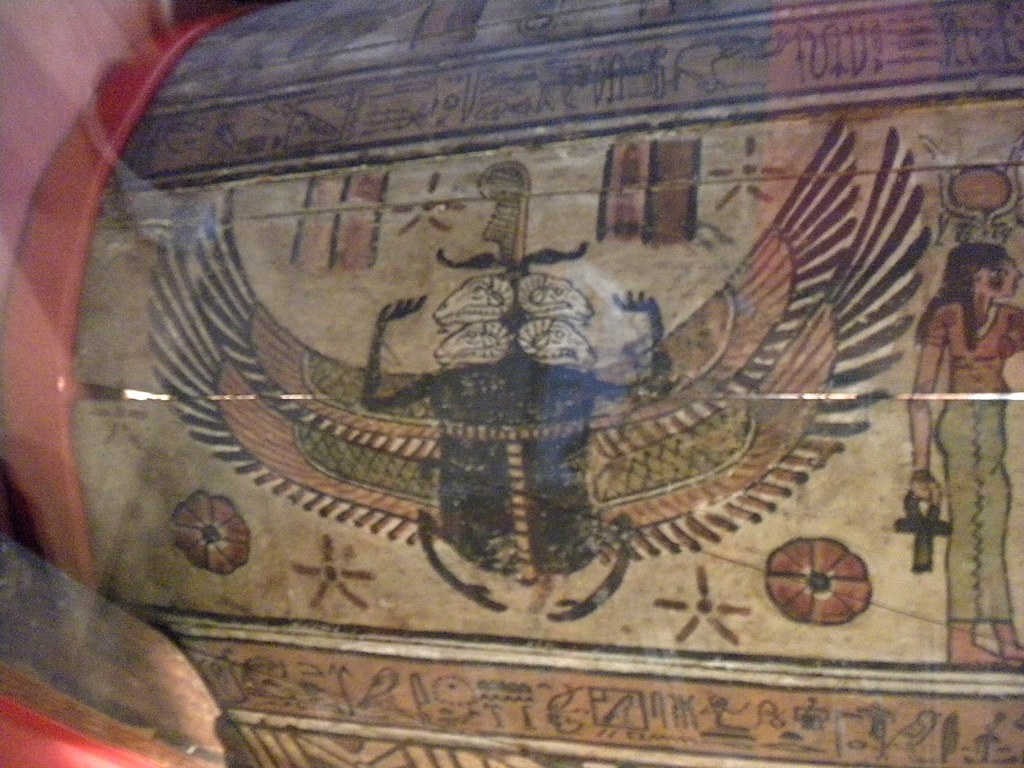
On the coffin of Soter, a black scarab with four wings, four heads, and a crown made from wavy rams' horns and a maat feather. My guess is this complex figure is Banebdjedet, the god which represents the four souls of the sun god.
Something in Don Webb's "Seven Faces of Darkness" alerted me to an aspect of solar myth linked to lust that I probably intuited when reading about Aleister Crowley's portrayal of the Devil as Pan-Pangenetor. It concerns the "total wakefulness of Mendes" via PGM IV. 3255-74.
"Total wakefulness" is linked to the erotic unrest meant to be induced by the spell and many other spells within the PGM, while Mendes links to B3-nb-Dd.t, or rather the Ba of Djedet, Banebdjedet, the Ba of Mendes in the form of a ram. Webb pronounces the name as Bab-Net-Tett and refers to it as a goat who personified lust. Believe it or not that's not totally off the mark. Hans Dieter Betz identified B3-nb-Dd.t as the name of a ram-formed incarnation of Ra, the sun god. Betz notes that this form of Ra was frequently identified with gods such as Pan and Priapus, both of whom were often associated with sexual desire. This is also predictably where we get into Herodotus' legend of the "goat of Mendes", which he identified with Pan.
Banebdjedet though was always traditionally identified with Osiris or as an aspect of Osiris, though he has been linked to other deities such as Ptah, Ra-Atum, Shu, and Geb. The ram was usually a symbol of virility and also the nocturnal form of Ra as Ra-Osiris. That this Ba of Mendes is associated with sexual desire and lust in the magical context makes sense, since rams were already symbolically associated with virility. Greek writers thus identified Banebdjedet, or a sacred goat alleged to have been worshipped at Mendes, with Pan. There is apparently even a legend about a Persian king who sacked the temple of Mendes and then went mad after eating the sacred goat.
I suppose then the link that Webb proposes between Banebdjedet/Bab-Neb-Tett and Baphomet is not a total stretch of the imagination. In fact, Eliphas Levi himself identified the goat-headed image of Baphomet with Banebdjedet based on Herodotus’ description of the “Ram of Mendes”, which in turn became the Goat of Mendes, either way a Greek reference to Banebdjedet as Pan. From an occult standpoint, that link is definitely credible, and speaks to solar lust and virility, and, in the context of PGM IV. 3255-74, its association with the power to overturn the order of nature, despite also affirming that order to some extent through procreation.
But now we have to look at a paradox. On the one hand, Plutarch associated the "goat at Mendes" that Herodotus talked about with Osiris, ironically on the grounds that Osiris is really Reason (Logos), which is pretty ironic for the lust that Herodotus associated with the goat. On the other hand, the association of Banebdjedet with Seth-Typhon in PGM IV. 3255-74 implies an association of the lust of the ram/goat with the power to overturn the natural order, which more closely befits the way Plutarch associatied Typhon with the sun and irrationality. Indeed, the ram as a solar symbol had both associations in ancient Egypt: positive creative divine energy on the one hand, and the power to threaten the cosmic order on the other hand. Such is the dual symbolsim of the Black Ram.
This article proposes a semiology-inspired model for the description of “demonic characters.” In this model, an image of a mythological char
Corvis Nocturnum has an interesting description of Baphomet that points to something valuable: "mindless, only filled with a Dionysian will to grow, feed, mate, survive and die, again and again, and it exists inside every living being." That description is essentially Crowley's description of Baphomet as the figure of The Devil in his Book of Thoth, which he identified with not only Pan but also Satan, Set, and the Sun.
Crowley refers to The Devil as representing creative energy in its "most material" form. The goat on the card is linked to Baphomet, as portrayed by Eliphas Levi, and to Pan. In fact, Crowley refers to the card itself as Pan Pangenetor, or Pan the All-Begetter. The card is also linked with the sign of Capricornus ("horned goat"), which Crowley interprets as a "goat leaping with lust upon the summits of the earth". The sign is ruled by Saturn, selfhood and perpetuity, and is exalted in Mars, the fiery and material energy of creation. The creative force represented by Capricornus is said to be "rough", "harsh", "dark", or even "blind". It is an impulse that does not account for reason, custom, or even foresight, divinely unscrupulous, without care for the result. Essentially, this force is "pure will". The sun, like The Devil, is seen by Crowley as a universe creative force. In fact, Crowley also argued in Magick in Theory and Practice that Satan was believed to be evil because he was associated with the burning rays of the sun, just like Typhon according to Plutarch.
The link between the goat and the sun in Crowley's context certainly had a lot to do with his own solar-phallic persona and solar myth, as Kenneth Anger noted, but it also inevitably lines up with certain Gnostic concepts of the Demiurge, some of which were really Devils. Yaldabaoth goes by another name: Samael. In this Gnostic context, the name Samael denotes the blindness of the creator of the world, a demon who created matter and claimed himself to be God, but was not the true God (remember, this is still by Christian standards). In early Christian writings "the creator of the world" was blind. In context this is meant to mean unaware and ignorant of the presence of Jesus Christ and the "true" God of Christianity. This argument is emphasized by Paul in the First and Second Epistles to the Corinthians, and in this respect Paul and some Gnostic sects are actually on the same page.
At the intersection of it all I think we get closer and closer to the kind of solar creativity and lust that fixates Satanism, "modern" occultism, and ancient pagan magic, perhaps bringing these worlds together in the forma of antinomian, Crowleyan, and satanic solar myth.
Banebdjedet (Banebdjed) was an ancient Egyptian ram god with a cult centre at Mendes. Khnum was the equivalent god in Upper Egypt. His wife was the goddess Hatmehit ("Foremost of the Fishes"), who was perhaps the original deity of Mendes. Their offspring was "Horus the Child" and they formed the so-called "Mendesian Triad". The words for "ram" and "soul" sounded the same in Egyptian, so ram deities were at times regarded as appearances of other gods.
Typically, the horned god Banebdjedet was depicted with four rams' heads to represent the four Ba's of the sun god. He may also be linked to the first four gods to rule over Egypt (Osiris, Geb, Shu and Ra-Atum), with large granite shrines to each in the Mendes sanctuary.
Demonologists in early modern times often imagined Satan as manifesting himself as a goat or satyr, because goats had a reputation for lustful behavior and were used in the iconography of pre-Christian gods like Pan and the goat of Mendes. The occultist Eliphas Levi in his Dogme et Rituel de la Haute Magie (1855) drew an image of the fictitious medieval idol Baphomet that conflated it with the goat of Mendes and the imagery of the Satanic satyr. The image of the satyr-like Baphomet and its supposed connection with Mendes has since been repeated by various occultists, conspiracy theorists, and neopagans.